
Working Model 2D
2D Dynamic Motion Simulation
Ocean-going research using motion simulation software
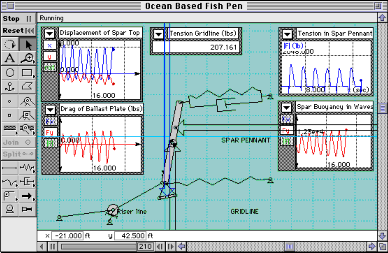
Net Systems of Bainbridge, WA, used Working Model to analyze what effects ocean currents would have on a spar holding a corner of its sea farming pen in place. Custom equations apply forces to model the ocean current, spar buoyancy, and the water's drag on the lower stabilizer disk. A spring/damper is switched on and off to model the drag the net places on the spar.
Aquaculture -- commercial fish farming in pen enclosures -- is becoming more prevalent around the world as an important source of food. The United Nations Food and Agriculture Organization estimates that by the year 2000 some 25% of total fish landings will be products of aquaculture. While fish farms inshore are commonplace, offshore aquaculture was, until recently, a tricky proposition. Recently, one company, with the help of computers and the latest in desktop engineering software, began modifying conventional trawling systems and applying the concept to offshore farming.
NETSystems of Bainbridge Island, Washington, has created an innovative open ocean pen system for raising fish. NETSystems studied the problem of keeping aquaculture pens stable in rough, open ocean waters for years before hitting upon the "ocean spar" concept: vertical steel buoys anchored to the sea bottom that serve as floating fence posts for nets, keeping them relatively stable through constantly shifting currents. Greater stability to the net pens means the fish will be less stressed, and the system itself will last longer.
NETSystems is the principal supplier of commercial deep-sea fishing net products in the North Pacific, including the Gulf of Alaska and the Bering Sea. The company has diversified to reflect a greater market demand for ocean farming, forming another company called Ocean Spar Technologies (OST).
Not Just for the Land-locked.
Gary Loverich, chief engineer and part owner of OST, needed a method to test the stability of his net pen system before deploying an expensive, large-scale prototype in the deep sea. He saw ads for Working Model, the motion simulation software from Design Simulation Technologies, but assumed that it was only suitable for landlocked mechanical engineers, not for modeling floating objects at sea. A colleague convinced him to order the demonstration disk anyway, and Loverich discovered he could model one of his net pen systems with just the demo copy. His reaction: "Holy cow." In no time, he purchased his own copy of Working Model.
Whether they are designed by the user in a separate CAD software or within Working Model's own drafting environment, Working Model applies the laws of physics to these models depicting the results of its motion analysis with simulations and graphic data readouts. This kinematics/dynamics analysis software will reveal whether a design can behave as expected under certain conditions. Properties such as mass, force, gravity and torque are applied to any model and then simulations are run to analyze the performance of both components and entire systems.
Recently, a 1:9 model of the net pen system was jointly tested by Ocean Spar Technologies and the MIT Sea Grant. The model was instrumented so that Loverich could gather hydrodynamic information on the system. He incorporated some of this test data into his Working Model simulations to optimize his sea farming system.
"There are different characteristics you may enter in a Working Model simulation; for example, you can enter load as a force or as a drag coefficient acting on a certain area of the design. So far, I feel most comfortable entering data as a force that I know is acting on a certain center of effort within the model." Loverich makes the distinction in the simulation between the center of effort (where all the force is concentrated) and the center of gravity because as a wave passes around one spar support of his net system, the velocity of the water in the wave is maximum at the surface, and decreases farther under the water, so the majority of the force or center of effort is not at the mid-point of the spar but toward the surface. Without this data, Loverich cannot make the best design decisions that will help maintain the shape of these net pens, especially under very strong currents (e.g., 2.5 knots).
Evaluating Fatigue.
Heavy currents and waves put a lot of fatigue on the net farming system. The most critical points are the loads on the synthetic mooring lines that retain the nets' shape while securing them to the spars. "The lines are constantly fatigued, from zero stress to maximum stress, back and forth," said Loverich, "and if you bend any wire enough times, it'll break." The ocean makes this effect even stronger. "Fatigue can happen at much lower loads than the breaking strength of the material, because the stress load cycles from zero to maximum so many times when it's in the water." These loads were measured by Loverich using Working Model.
"What I wanted to find out with these simulations is the orders of magnitude. Are the waves causing a 10,000-pound load on these ropes, or a 2,000-pound load? I don't need a precise answer, but I need to know if it's plus or minus 500 pounds. That's as close as I want to get, because I'm going to overdesign my system anyway for the forces I can't foresee, such as a boat impact. Working Model can show me which wave frequencies are going to be the most critical. It's not necessarily the biggest waves -- it might be the medium-sized waves out of phase that might put on the biggest load."
Once he finds the proper load on the mooring lines, and the acceleration of the spar, then Loverich exports that Working Model data to his FEA program and tests the system to make sure the hardware connecting the two components is strong enough. Loverich uses COSMOS/M to analyze this aspect of his system.
The clarity of its graphical user interface, documentation, and Windows-based environment made Working Model easy to get acquainted with, and he began to use it immediately as part of his overall prototype analysis work. "We've modeled and analyzed our system every way we can, using long-hand static equations, the ninth-scale model, our FEA package, and now with Working Model. All of these methods have yielded complementary results, so we feel pretty confident that we understand the load environment we're dealing with," said Loverich. Simulating Wave Force. One doesn't actually see waves of water moving across the computer screen when Loverich runs a Working Model motion simulation. Instead, a vertical spar or spars float in a coordinate axis system. The wave force is depicted by an arrow, which increases or decreases as the wave passes. He measures the tension on the anchor lines, and the velocity of the spar buoys.
"In Working Model I am able to move the connections on the spar buoy to different locations to enhance the stability of the system. I can move a ballast weight, the attachment points, anchor lines, and the net, because there are plenty of attachment points to the buoys." While conducting his wave frequency simulation, Loverich subjected two linked spars to phased wave loading (i.e., where the load isn't hitting the spars at the same time).
The waves forced the spars into certain periodic motions, and once that motion became stabilized, Loverich would end the Working Model simulation. Depending upon the simulation, that might take just two or three wave crests, or as high as 20 or 30 wave crests. "I extend the time until I see some stability," he said. Loverich then analyzed the phasing of the waves and how it affected the tension values on each mooring line and attachment.
Loverich has also simulated the release of a single spar into the ocean using Working Model, waiting for it to oscillate to equilibrium where it will sway equally around its center of gravity. "Waves will cause this type of forced motion so that it's repeated as long as the wave operates." But Loverich is also interested in a static simulation of a single spar floating in still waters. "I have to know how it is going to float in still water, because that will influence how it acts when waves come by. I used Working Model to measure the static forces on all the anchor lines. It's a way to calculate the median load."
Deploying Net Pen System Safely.
The single spar Working Model simulation helped Loverich determine the safest way to lower the spars into the water, and even answered his questions about how many workers he can safely afford to fit atop a platform that forms the top of each spar. He adjusts the ballast weight to make the spar sink to the desired depth, what is called "freeboard" (the amount of spar above the water line) and "draft" (amount of the spar below the water line) is at an optimum ratio. Adding weight to the crow's nest working platform will lessen the freeboard. Modeling this situation with Working Model is important because deploying the net pen system safely is half the battle in ocean aquaculture. The nets, spars, and crane equipment are heavy, so safety is a concern. And Loverich wants the freeboard to be as minimal as possible in some applications, without ruining the net pen stability, so that lifting other portions of the net pen apparatus is not too difficult.
All of these Working Model simulations are critical from a financial perspective. Deploying such a complex system of spars and nets is difficult at best in open seas, and the environment plays an important factor in the execution. If equipment hasn't been tested properly, it can break unexpectedly, and at inconvenient times. Bad weather can also prevent repairs for days or weeks, time that is money to any fishing operation. Loverich estimates that it costs 40 times as much to repair something at sea than in the shop. By using motion analysis, he is decreasing his risk and increasing the dependability of his product.
Ocean Spar Technologies will use Working Model not just to perfect the net pen system but to continually customize it for different fisheries around the globe. Ocean Spar will keep various net pen models in the simulation files, and when a customer supplies local tidal and current information, or requests a different net pen configuration, Ocean Spar will be able to input the variable data and learn what adjustments will have to be made to customize the product accordingly. "Our engineers will call up Working Model and put in the local parameters and then we'll simulate the motions and forces that might impact our system."
Kinematics/dynamics simulation is saving Ocean Spar Technologies money as well as time. The time to market this complex and vital product has been slashed because of the help Working Model has provided in simulating the motions and forces that will affect this innovative product. And Working Model helped explore a complex floating system, not just single land-based masses -- a flexibility that was employed to great advantage by this company. By continuing to employ Working Model simulations, Ocean Spar will retain its competitive edge in the ocean aquaculture market while improving the ability of people worldwide to sustain their own fish farming industries.
 Quote
Quote Evaluation


